What to Wear in 70 Degree Weather: Not as Warm as It Sounds
Seventy degrees is the temperature everyone gets wrong in both directions. Shade, humidity, wind and the evening drop — and how to dress for the hours you’re actually outside.
 WearToday Team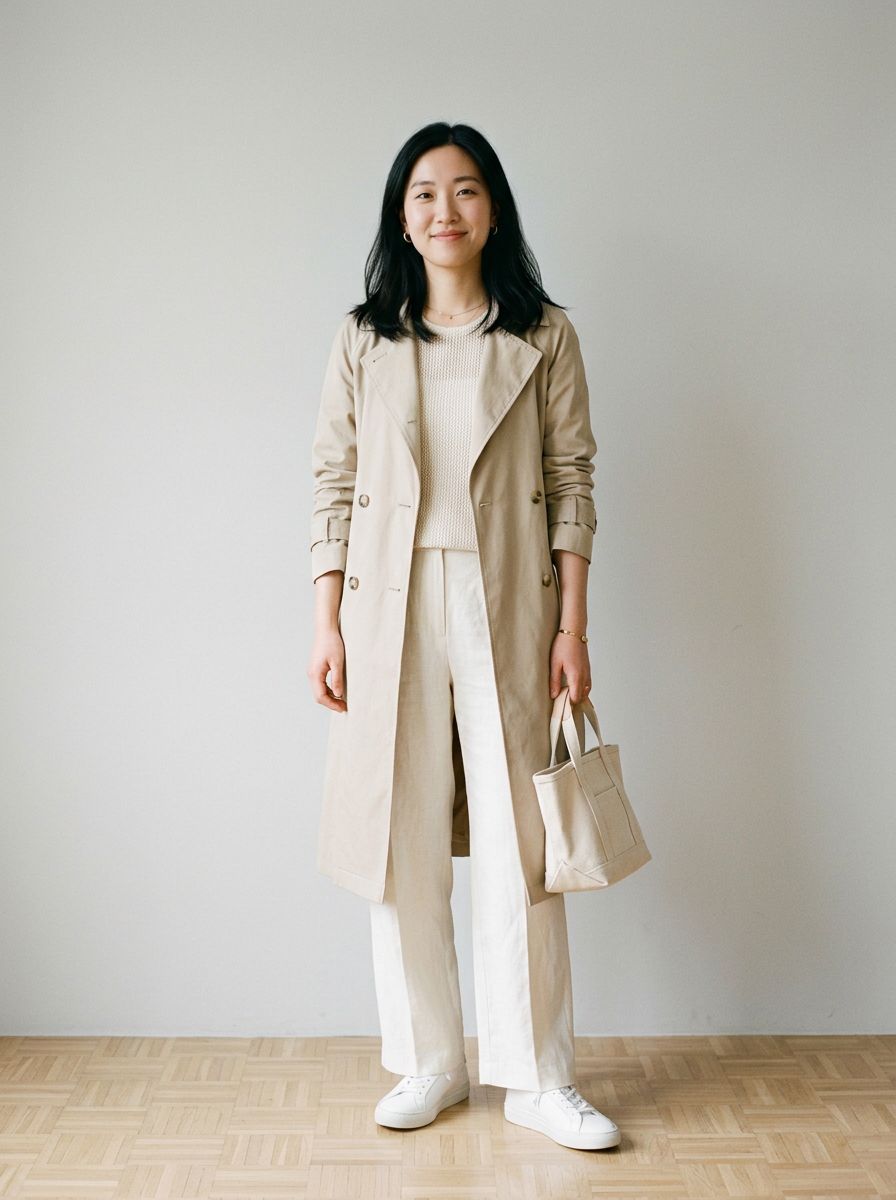
Seventy is the temperature nobody dresses correctly, and the reason is in the number itself: 70 sounds warm, so people dress for summer. Then they spend the afternoon carrying a jacket they regret, or standing in shade with their arms crossed.
Seventy isn't warm. It's neutral — the point where your own body heat starts working with the sun instead of against it. That makes it less forgiving than it looks.
The two ways to get 70 wrong
You dress for the number, not the day. Morning is 57, you put on a light sweater and a jacket, and by 2pm you're in the sun at what feels like 80 with both of them in your hands.
You dress for the sun, not the shade. Direct sun at 70 and shade at 70 are easily ten degrees apart in how they feel. If your day is half indoors — a café, an office, a train — you're dressing for the quarter of the day you're in direct light.
Both mistakes come from the same assumption: that 70 is a single thing. It isn't.
Four things change what 70 actually feels like
Sun or shade. A 70-degree day in full sun on pavement is genuinely hot. The same day sitting in the shade of a building with a breeze is pleasant and slightly cool. Where you'll be standing matters more than the number.
Humidity. Dry 70 is a beautiful day. Humid 70 with no wind is oppressive, and it feels closer to 80. This is the variable that makes your fabric choice matter — airflow is the whole game when it's humid, and the wrong shirt traps it.
Wind. The mirror image of the cold-weather problem. 70 with a steady breeze feels like 63, and the outfit that was fine walking to the car is not fine at a table outside.
The swing. A 70-degree day has the widest usable range of any temperature. The daily high is a 2pm number; the morning and evening are regularly 15 to 20 degrees below it. Build for the coldest hour you'll actually be outside — that's the number your outfit has to survive.
Dress for the hours you're outside, not for the high
The forecast high is the most misleading number in the app, because it describes a moment most people aren't even outdoors for.
The fix is to think in hours instead. Which hours will you actually be outside, and which of those is the coldest? A commute at 7:45 and a walk home at 6:30 are two completely different climates on a 70-degree day, and if both are in your schedule, the outfit has to hold at both.
Then add exactly one removable layer — and only if you can carry it. A jacket you resent by noon costs you more than the two minutes it saved you in the morning.
What to wear at 70, for men
A normal day. A heavyweight tee or polo, chinos or light denim, low-profile sneakers, and one light overshirt. The overshirt is the entire system: on at 8am, off at noon, on again at 7. Nothing underneath it needs to change.
A workday. A light button-down with the sleeves rolled, an unstructured blazer you can take off and put on a chair without it looking like laundry, and trousers that aren't heavyweight wool.
Humid 70. Linen or a light cotton-linen blend, an open collar, and no denim jacket over a tee — that combination is a humidity trap and it's the most common 70-degree mistake there is.
What to wear at 70, for women
A normal day. A light knit or a clean tee with straight-leg denim or a cotton midi skirt, sneakers on a dry day, and one layer you can carry.
A workday. A lightweight blazer or a fine-knit cardigan over a base that works on its own — because at 70, you will take the top layer off and it needs to be a complete outfit when you do.
Humid 70. A loose dress in a breathable fabric, open shoes, hair up, and no tight waistbands you'll regret by 3pm. Airflow beats coverage.
What to avoid at 70
- Heavy cotton over cotton. A denim jacket over a tee is the classic humid-day mistake. Two layers of cotton with no airflow is worse than one layer of the wrong fabric.
- Thick socks and heavy shoes. Your feet decide whether a 70-degree day feels fine or unbearable.
- All black in direct sun. Thermal mass is real, and dark fabrics in sunlight run measurably hotter than light ones.
- No layer at all. The 70-degree evening catches more people out than the 70-degree afternoon ever does.
The 70-degree evening problem
Here's the part one number can't solve: whether the day is 70 matters less than which hours you're actually outside.
A 70-degree evening feels different from a 70-degree afternoon for a reason that has nothing to do with the number: your body reads the change, not the temperature. Two hours in air conditioning makes 70 feel like a chill; two hours in the sun makes the same 70 feel like relief. The layer you carried all day is the one that saves the evening — which is exactly why "no layer at all" is the mistake that shows up most at this temperature, and almost never in the morning.
Drop the number ten degrees and the layering system that starts doing the work again at 60 takes over.
Why 70 is hard at 8am
At 8am you don't know that lunch will be outdoors, that the meeting will run long in a room with the air conditioning at full, or that a breeze will pick up at five. You're building an outfit for a day that hasn't happened yet, and once again the three inputs are in three different places: the weather where you actually are, what the day is asking of you, and what's hanging in your closet right now.
At the other end of the year, where the coat comes first, the same three inputs invert — the coat decides, and everything underneath gets out of its way.
You can reconcile all three yourself at 7:40am. Or you can hand it to something that does it in one pass — and remembers what worked last time.
Start with what you own — your weather, your calendar, your closet, in one pass.