What to Wear in 60 Degree Weather: The Layering System You Can Actually Undo
What to wear in 60 degree weather is really a question about ranges and schedules. The three-layer system where every layer is built to come off by 2pm — with outfits for men and women.
 WearToday Team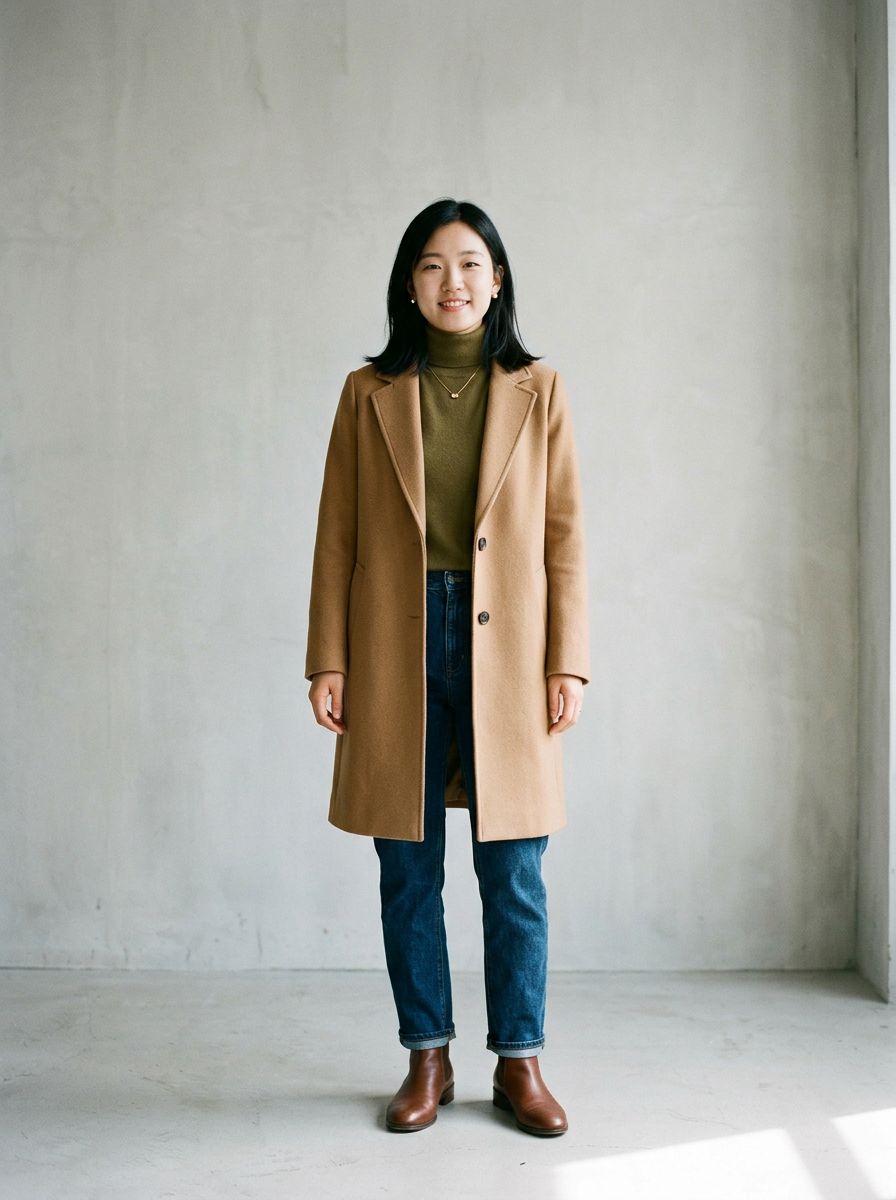
Sixty degrees is the most annoying temperature in the closet. Below 55, you commit to a coat. Above 70, you commit to short sleeves. At 60, every outfit is a negotiation with a forecast that will be wrong by 2pm.
So most advice does the same thing: "wear layers." Thanks. That's not an outfit, that's a shrug.
Here's the actual problem with 60 degrees — and a system that solves it.
Why 60 degrees defeats normal outfit advice
The temperature isn't the variable. The range is.
A 60-degree day is rarely 60 degrees all day. It's 52 at 8am on the walk to the train, 66 in the sun at lunch, 58 again by the time you're heading home. Any outfit that works at one of those moments fails at another — which is why you end up carrying a jacket you never wear, or shivering in a shirt you can't layer.
There's a second variable too: 60 in still air and 60 in wind are two different outfits. Wind strips the warm layer of air your clothes hold against your skin. A 60-degree day with a 15mph wind reads closer to 50. Same number, different wardrobe.
And a third: what the day is asking of you. A 60-degree client meeting and a 60-degree Saturday errand have the same forecast and nothing else in common.
Layers solve all three — but only if they're built to come off.
The three-layer system
The mistake isn't dressing too warm. It's dressing warm in a way you can't undo by 2pm. Build the outfit so each layer can be removed independently, in public, without making anything underneath look wrong.
Base layer — the part nobody sees coming. A fine-gauge knit, a plain tee, a light button-down. This is what's still on you at 2pm when everything else is in your bag, so it has to stand on its own. Keep it solid-colored and fitted; it's the layer that gets photographed when the jacket comes off.
Mid layer — the one that does the work. Here's where 60 degrees is won. A merino crew, a chunky cardigan, a denim or chore jacket. Merino has a wider comfortable range than cotton — it keeps you warm when the wind picks up and doesn't turn into a sauna indoors. This is the layer you'll remove and re-add four times a day, so pick something you can tie around your waist or ball up in a bag without it looking wrecked.
Outer layer — insurance, not the outfit. At 60 degrees the outer layer is for the morning and the evening, not the middle of the day. A light trench, an unstructured blazer, an overshirt. The test: can you carry it for six hours without resenting it? If not, it's too heavy for a 60-degree day.
Two rules that matter more than the layers themselves:
- Shoes and socks before everything else. Cold feet ruin a 60-degree day faster than a missing jacket. A 60-degree morning on a stone platform at 52 degrees is a boots-and-socks morning. If you're walking in the evening, closed shoes, not sandals.
- Nothing that needs dry-cleaning. 60 degrees usually comes with a chance of rain in spring and fall. If the mid layer can't survive a drizzle, it's the wrong mid layer.
What 60 degrees looks like for men
A meeting day. Oatmeal merino crew under an unstructured blazer, dark straight jeans, leather sneakers or loafers. Warm at 8am, correct at 10am, still put-together at 4pm when the blazer is on the back of a chair.
A normal day. Plain heavyweight tee, open overshirt, light trousers, a clean low-profile sneaker. The overshirt comes off at noon and goes back on at 6.
A cold-morning day. Add a thin base under the merino and swap the sneakers for boots. Nothing else changes — that's the point.
What 60 degrees looks like for women
A meeting day. Fine-gauge knit, tailored trousers or a midi skirt, a light trench. Add a thin scarf — it's the cheapest temperature adjustment you own and it reads as a style choice rather than a survival measure.
A normal day. Long-sleeve tee or light knit, straight-leg denim, a cardigan that works open or closed. Sneakers if the day is dry, ankle boots if it isn't.
A cold-morning day. Knit dress or fine-knit base with tights, tall boots, an overshirt on top. The base stays constant while everything around it adjusts.
The pieces are mostly the same across both — the defaults aren't. The safe shoe, the acceptable layer, the line between "put together" and "trying too hard" all differ, and generic "wear layers" advice flattens both. That's also why what to wear when the forecast can't make up its mind has no single answer — it depends on which hours the day asks of you, and what's actually hanging in your closet.
The 8am problem: you don't know what the day will be
Here's the part no list of outfits fixes. At 8am you don't know that lunch will be outdoors, that the meeting will run long, or that the temperature will swing 14 degrees before you get home. You're building an outfit for a day that hasn't happened yet.
That's the gap a forecast can't close — and it's the gap most people solve by overpacking or by being cold for an hour.
The fix is to stop treating the morning decision as a forecast question and start treating it as a schedule question. Ask what the day is actually asking of you — a client meeting at 10, dinner at 8, a commute that's mostly walking — and the layers sort themselves out, because now you know which hours the outfit has to survive.
And when the number drops, the whole approach changes — 60 degrees is the easy one; 50 is where it gets serious.
Test your outfit before you leave the door
Three checks, ten seconds, no mirror theatrics:
- Can you remove any one layer without the outfit collapsing? If taking off the cardigan leaves you in something you wouldn't wear in public, the base layer is wrong.
- Does it work at the temperature you'll feel, not the one on the app? If the forecast says 60 and there's wind, dress for 50.
- Can you carry the outer layer all day? If not, leave it and take a bigger mid layer instead.
On the other side, when 60 turns into 70, everything above changes — the layers get lighter and the mistakes get different.
The reason your 60-degree outfit keeps failing
It keeps failing because the three inputs — the weather where you actually are, what the day is asking of you, and what's already hanging in your closet — live in three different places. You check the forecast, look at your calendar, stand in front of the rack, and try to reconcile all three in your head at 7:40am with a coffee in one hand.
You can do that reconciliation yourself. Or you can hand it to something that does it in one pass and remembers what worked last time.
That's what WearToday was built for — it takes your weather, your plans and your actual closet, and gives you a complete outfit with the reasoning, so the 60-degree morning stops being a negotiation.
See what it suggests for your 60-degree morning — start with what you already own.